Tuesday, 30 July 2013

Education In Zambia!


In the 5 years Bookbus has been active in Zambia we have worked in a variety of schools, from preschools to high schools, government funded to volunteer run, from 35 pupils to 1800 but one thing is always common throughout, the eagerness of the children to learn.  They see education as the key to improving their situation in life.  Even on holidays and through teacher’s strikes the kids turn up at school just to see if anyone will teach them.  Nearly all prefer term time to the three, one month, slots of holidays they get!!

The education system in Zambia suffers from a severe lack of funds, materials and teachers. But that said, the pupils are some of the most willing and keen to learn that you will find anywhere. And everywhere we have arrived with the Bookbus and taught, within Zambia, we have been greeted with enthusiasm, curiosity, open arms and big smiles.


Basic state education begins when a child is 6 or 7 with grade 1.  Grade 1 to grade 7 comprises basic education which should include every child and should be free.  This is, however, not the case. Many children do not attend school either because of the cost or because they have to work, take care of a sick relative or new baby or do chores around the homestead. To attend a basic school the pupil must have a uniform, school shoes and bag, exercise books and pencils and this list obviously excludes many children and there are often unofficial “fees” to pay. These can be monetary or in the form of “donations”, for example a child must bring a bag of cement or a ream of paper before he or she can enrol for the school year.


At the end of grade 7 a pupil sits exams and only if passes are obtained can they continue to grade 8 & 9 and the same happens in grade 9 to be able to complete school up to grade 12. There are relatively high fees to be paid every year from grade 8 upwards so many intelligent children end up leaving their education early.

The students take 7 subjects up to grade 7. These being: English, Mathematics, CTS (creative, technological studies - where there is no actual creative work done – it’s all theory!), SDS (social development studies), Tonga (or other local language depending on the province), Literacy and Science. Almost all learning is done by copying from the board and children are rarely asked for their own opinions or to use their imagination. ALL exams in grade 7 are multiple choice, they don’t have to write anything. In theory a pupil who can read and write very little English can pass grade 7.

 
As well as the government schools, Zambia has a large number of Community schools which were originally developed for children who could not afford to attend government schools. They were started by members of the community, often under a tree or in a church building.  These schools are under-funded, under-resourced and operate with a lack of trained teachers, they have to have finished high school but have no formal teacher training although they mostly have real passion to teach the children. Nowadays the government has realized the importance of these schools, especially in areas where the population is growing and some are beginning to be integrated within the ministry of education, operating with a mixture of paid trained teachers and volunteer teachers, who mostly obtain a small salary from the community.

 
Basic government schools are usually a little better equipped and resourced than the community schools but the classrooms are just as bare, the teachers often have huge classes and very little materials but the children are keen to learn wherever you go.


Whichever type of school we visit it is important to always bear certain things in mind which are very different from what we are used to in the UK and the Western world.  Classes can be huge with a normal class being 40 to 50 pupils but anywhere up to 100 is possible.  The children aren’t used to being asked for their own opinions, being creative or working in small groups, education in Zambia is very much learning by rote.  They aren’t used to any creative subjects, things like art, drama or music.  There simply aren’t the resources, training or equipment available and no provision in their curriculum, and because the classes are overcrowded small group work never occurs.


Classes may have a wide range of ages.  This is because some children do not start school until they are older, maybe it is too far to walk when they are 7, sometimes they have to miss a year to two if their family needs them to work, or care for a sick relative or maybe they can’t afford the fees.

There is always a very wide ability range in the grasp of English, some pupils may be fluent whilst others struggle with the simplest sentences.  You also find that many can read out loud but then have no understanding of what they have read. It is often that the ability of a child’s English is greatly influenced by their home situation (whether they speak English at home) and not just by their schooling. It’s important to remember that English is not their first language, most of them speak 3 or 4 African languages perfectly but they ALL want to learn English. It is the official language of Zambia and without a good grasp of it jobs with good prospects are out of reach.

And one important thing – do not equate Zambian children’s ages and their interests with those of children at home. Teenage boys are just as fascinated with the storybooks and the art supplies the project brings, as the preschoolers! They have never had access to the things which we take for granted. The enthusiasm for learning is everywhere and joining the Bookbus as a volunteer will let you experience this all first hand!


Kelly July 2013.

Tuesday, 2 July 2013

Latest news from Ecuador

The children of Ecuador have been having a whale of a time on the Book Bus since 2010. 
Sophie Karlsson is coordinating this year's project in Puerto Lopez 
(where humpback whales can be seen from the beach in July and August)

Sunday, 23 June 2013

A Great Day!


Every day on board the Bookbus is exciting, rewarding and special but last week we had an especially fantastic day. Early on Thursday morning we drove out to the village of Muke, somewhere the Bookbus has never before been, to visit a small community preschool. The founder of the school had heard of the Bookbus and seen in it nearby villages and wished for his community to also benefit, so early one morning he arrived at our camp and invited us to visit him. We didn’t want to disrupt our other programs so we went early and planned to spend an hour there before heading to Simoonga, our usual Thursday School.

Muke is a very rural community about 20km from Livingstone. It has around 300 households, all without electricity or running water. Most people are subsistence farmers, although some work in nearby commercial farms. There is no school and children have to walk to Simoonga, so many of them begin school late as the walk is too far for them to start at age 7. Edwin, the founder of the preschool, saw that the need for a preschool was great and set about organising with the village headman and elders. Some of the community were behind him but even today many parents still don’t see the importance of education, as they themselves grew up without it. At present the preschool meets in the mud brick church building and conducts lessons outside under the tree, they are part way to building their own school and add a little to the structure every time they get some funds.


Currently there are about 30 pupils at the preschool, but as we were just 2 volunteers this week that was a good number. They were very shy when we first arrived, some were afraid of the “m’zungu” visitors, the first white people they had met. We had brought snakes for them to colour and for many it was the first time using crayons. Once the snakes were coloured we cut them into spirals and stuck them on string. The children, from age 3 to 7, were so excited. Never before had they seen anything like this! We finished with the story “Animal Bop” and with each page the kids became more animated and happy to dance with us, like the animals in the book.

We met the headman who gave us his blessing to work in the village, he told us we are free to come whenever we want and to move around the village as if it was our home. Traditions like this are still very important in society and very much alive in rural Zambia. It was an honour to be invited to Muke and to meet the children and members of the community, hopefully we can work together with the village, and plans for a holiday club out here are already underway.

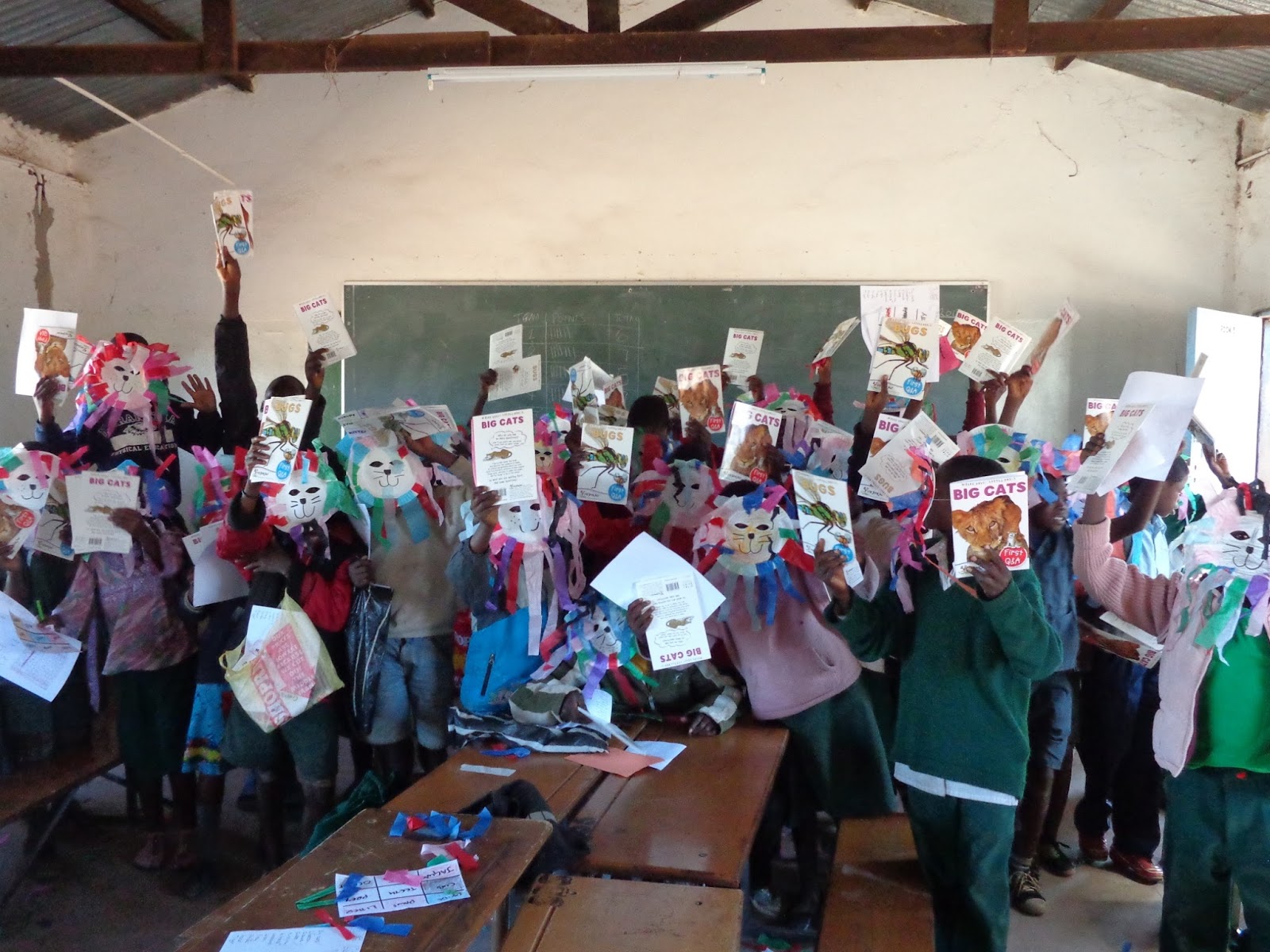
We then drove back to Simoonga, the grade 6 class were hanging out the window frames waiting for us to arrive. The grade 5 and 6 classes are about 40 pupils here, so being just 2 we decided to work with them as just one big group. We based our lessons on the Miles Kelly “Big cats” book.  We had prepared a quiz, so we put the kids in teams, gave them paper and markers and we had questions on big paper. Each team had to find the answer in the book, write it on the paper and hold up the answer before the time ran out! The competition was fierce but they loved it, we followed that with a giant “Big Cat” Bingo, a word search and then lion masks! 


As it is only the 5th week we have been to Simoonga, everything is still new for them; there was a loud cheer when we showed then the prototype mask! However this was very much overshadowed by the giant cheer when we told them they could keep the Big Cat books as well as another, which we handed out! They were over the moon, and kept coming up to ask if they could really take them home. The joy in the classrooms was enormous and infectious. It was really one of the most rewarding days, I can remember! Thank you to Miles Kelly Publishing from the children of Simoonga!

Kelly June 2013


Monday, 17 June 2013

The Book Bus starts in Puerto Lopez on 24 June 2013
Read Helen Keep's experiences from the project last year:

Marta, Helen(c) and the children from Puerto Lopez

I spent two weeks volunteering with the Book Bus in Puerto Lopez, Ecuador, in 2012. It is a fantastic project, and seems to be very successful at enthusing the kids with reading - certainly they welcomed us with open arms every morning! Each session started with a warm-up exercise - everyone singing a song, complete with actions! Then we read a story to the kids, which they really seemed to enjoy - in fact, on one occasion, the kids in my group "took over" and all 6 of them (in unison!) very enthusiastically read the book to me instead!! After this, they did a craft activity related to what we had just read - making penguins, butterflies etc.

Puerto Lopez is in one of the poorer areas of Ecuador, and the general educational levels are not as high as in the West. The schools had very few resources, and very few books (other than those provided by the Book Bus). So it was wonderful to be able to help encourage the children with reading, as I believe this is essential in helping to raise the educational standards. Obviously the main aim is to help the kids, but I got a lot out of it too. It was so satisfying to see how much they enjoyed what we were doing with them. And it is a great way of learning about the culture of a country, and what real life is like there - you learn much more about what a country is really like than you would if you just visited for a holiday. We also got some free time each day, and at the weekend, when we were able to explore the area. And of course, my Spanish improved enormously!!
 

The people running the project were all lovely, and looked after us really well. I will certainly be doing this again in the future, and I would encourage anyone else to try it. It's making a massive difference to the kids, and it's also great fun.

Un abrazo


Helen

Wednesday, 12 June 2013

10,000 Books!!


An exciting shipment for Bookbus arrived here in Zambia last week. I got a call from customs while at school on Thursday. ‘Come and collect your 600kg of books today,’ they said!
10,000 books donated by Miles Kelly Publishing for the Zambia and Malawi projects were waiting for us, so we loaded them onto the Bookbus and brought them back to camp. What makes this shipment even more special is that these books are branded with the Bookbus logo and for every book sold in the UK, Miles Kelly will make a donation to The Bookbus Foundation. So it is a HUGE thank you from everyone involved in the Bookbus to all at Miles Kelly!!

Today we took the first of the books out into the field. We learnt, amongst many things,  about why ladybirds have spots from the “Bugs” book, using the book to emphasis what nouns and adjectives are before making flying ladybirds.

We then distributed the first of the books, with all the pupils in grades 5, 6 and 7 at Twabuka School getting 2 books each to take home. They were SUPER excited and the first task was to make sure they wrote their names in their books, very important!


Sets of the 10 different titles will be given to the schools to add to their Bookbus libraries, some will be sent to South Luangwa, Lusaka and Malawi and of course some will find their homes on Charlie and Matilda our two mobile libraries!

Thank you to all at Miles Kelly Publishing!
Kelly - June 2013


Tuesday, 11 June 2013

HAPPY VOLUNTEER WEEK! (On Africa Time)


Hello Book Bus followers from Mfuwe, Zambia! With the help of children from our partner schools in The South Luangwa Valley we put together a video for Volunteer Week to say thank you! Due to internet issues, we have just now been able to upload it online. A big thank you to Croc Valley Camp for allowing us to eat up your bandwidth to publish the video online! You can view the video on Youtube at the following link:

Happy Volunteer Week 2013 from South Luangwa!

The music in the background is a song titled 'Say Ilil Che' (which means "It's Good") by Slap Dee, a famous Zambian musician who performed at the Nkalango Music Festival organized by the Chipembele Wildlife Education Trust in Mfuwe last year. Nkalango translates to "The Bush!" or "The Wild!" and the concert promoted the importance of the South Luangwa wildlife and conservation education. The event gave many local students the opportunity to perform on stage as well as just have fun singing and dancing for an afternoon!

Thank you to all of our past, present, and future volunteers for all that you do. The Book Bus would not be possible without all of your hard work and because of you children in the South Luangwa gain access to multitudes of colorful books, coloring pencils and crayons, colored card and crafts and gain priceless multicultural learning experience. Thank you from the bottom of all our hearts for everything you do to enrich each child's learning experience!

Sarah- June 2013

Friday, 7 June 2013

Life in Livingstone!

The Bookbus 2013 season in Livingstone is well underway and our volunteers have busy reading with hundreds of children over the past weeks. We visit a variety of different kinds of schools, some community, some part community, part government and one government school. We work with children from as young as age three up to sixteen. It isn’t unusual here to find children of a big age range in one class, this is because they may have started school late, had to drop out for some time to work or take care of a family member or they may not have had the means to support themselves in school. So having a sixteen year old sitting next to an eleven year old is common place and the children all take it in their stride.
 
 
One of the things that almost all volunteers comment on after their first few days in school is how much the children help and support each other. There is no laughing at the one who is struggling or making fun, his or her classmates will strive to help them in any way possible. We also see this in the way that young children (as young as 5 or 6) take care of younger siblings. They are often left in charge as parents are busy working, so seeing a 7 year old walking around with a baby strapped to her back, or a 6 year leading his toddler brother down the road is a common sight. Children here learn to be self sufficient much earlier than in Western countries, they have more road sense and often fend for themselves on a day to day basis. We see this when the Bookbus drives down the road, in the amount of children who swarm from their houses and follow us, without informing anyone where they are, or in the children who accompany us on village tours, holding the hands of strangers, walking away from their homes!
 
The village of Sinde, the home of Twabuka School, is still getting it’s Wednesday Bookbus visit and it’s here that a member of the community will take all volunteers on a village tour to show them the way of life for the children they have been reading with. They meet the village headman, who weaves the most beautiful baskets, learn how they build their houses and long drop toilets and about many other aspects of village life. The Bookbus is well respected in the area and its contribution to the community well known, so when the yellow shirts are seen walking about there is no feeling that we are intruding on their daily life, instead we are smiled at and welcomed. For many volunteers this is one of the highlights of their stay in Livingstone.

At Twabuka they have begun a feeding programme so that ALL pupils get one meal everyday at lunchtime. This meal is always of the Zambian staple, N’shima, made with maize flour and water, which is then served with either beans or a vegetable. Providing the children with a meal means improved attendance as parents will send their children to school to ensure they have at least one meal a day. Unfortunately such feeding programs are not paid for by the government so do not readily occur, it is mostly through private donors that such things can take place. It’s great to see all the kids tucking in to their lunch. They have to bring their own plate/bowl and you often see brothers and sisters telling each other to hurry up eating and being chivvied then to use the water pump to wash up so the next one can have their turn with the plate!

 
The children at Simoonga School have now had 4 Bookbus visits and they are loving Thursdays. Their teachers tell us that Thursday always has full attendance now. The other week we were slightly late because of a small truck issue (T.I.A!) and then when we started pulling up the track to the school we heard a big shout from the open windows. The teacher told us the kids were afraid we weren’t coming but then when they heard the truck engine they all started cheering! I have rarely met such interested teachers as the two lady teachers of grades 5 and 6. They never leave the classroom, and are interested in looking at all the books and the activities the groups are doing and then choosing the craft they like best; they want to have a go at making it too! Every week they tell me how good it is for their pupils to have the Bookbus visit their school. They normally have no exposure to these kinds of books and hands on activities. We often have to instruct in the use of scissors and glue for the first few weeks at a new school, but they soon get the hang of our style of working and then…there is no stopping them!!
Kelly - June 2013