Sunday, 8 September 2013

Another fun fortnight!


The final weeks of holidays in Livingstone saw many activities on the Bookbus. We spent 3 days at Sinde parked up in the centre of the village, with more and more children coming each day to read, play games, make art and learn new things. The older children spent a day learning about volcanoes and then did a science experiment making their very own exploding volcano; Which had to be re-enacted at the end of the day for all their younger siblings.


We also spent 3 days at a new village, Delevu, about 1 hours drive from Livingstone. Many of the children here don’t have any formal education as the nearest government schools are too far away. There is a small community school, run out of a small church and when we arrived the first time the children piled out of the church to see what was going on. They were quite shy the first day but they soon got into the stories and the activities. The loved playing with our homemade parachute, they all have a look inside the Bookbus and joined in with all our favourite songs.

 
And each day we arrived the line of children running behind the bus got longer! On the final day we gave each child their own book to take away and they were thrilled, waiting in a very orderly line for their turn to get their name written in their book.
 
 
It is also a great pleasure to see them engrossed in their books, even if they aren’t able to read. You can see there is a real sense of pride in owning their very own book, something that without the Bookbus is almost unobtainable in these rural villages.
 
 
On the way to these rural schools we are often lucky enough to spot elephants, giraffes, impalas or zebras. This week we saw a whole family of sable antelope, which is very rare. It was just a taster for our weekend safari in Chobe National Park, Botswana. We all spent the weekend being amazed at the sheer number of animals, there were literally thousands of zebras and impalas and hundreds of giraffes and elephants. We also saw lions and in the evening a leopard, which was pretty close to our overnight bush camp.

 
Two days each week we went and spent time at Lushomo Home, in Livingstone, a refuge for young girls that have been sexually abused. It was a big contrast to the big groups of noisy children in the villages but it was a fantastic experience getting to know these girls. They love to read and do crafts and it was obvious they rarely have the opportunity to do these things. They grew more and more confident each day, their shy smiles turning into genuine laughter and huge grins. We also left them with their own books, which I know they will treasure, share and keep on rereading.
Kelly September 2013


Tuesday, 20 August 2013

One week - Two New Schools.

The first week of holiday club on board the Livingstone Bookbus 2013 has been one of the busiest but most memorable ever. We visited 2 new schools, for 3 days each, even going in on Saturday. Both schools were rural, around 30km from Livingstone and the turnout for the Bookbus was exceptional.

The first three days were at Kamatanda Village, where there is a community preschool and school with grades 1, 2 and 3. The nearest government school is 9km walk, this prohibits the younger children beginning school until they are older, so the local community, backed by a retired teacher, started their own school. It is in a straw and mud hut but the children flock in and love to learn.

 
When the Bookbus first arrived, they had never seen anything like it before. There was a lot of open mouthed staring but we just jumped straight in reading some classic stories and getting the kids and teachers to join in with the actions. Being far from town and not on the tourist trail, villages like this seldom get visitors and if they do it may just be a fleeting visit, As Ann the headteacher said to me, “If anyone visits us, they are soon come and gone. We can’t believe that you have spent 3 days in our village. Thank you. Our children will never forget this.”

Lots of curious parents and onlookers were always around, coming to see what we were doing. There were also some older children from the village who joined in and in one morning we turned Kamatanda Community from this

to this!! 

Fun was had by everyone and the teachers were busy learning by doing. They thanked us for teaching them new skills and ways of interacting with the children.
 

Each day we returned, the welcome would get louder and the number of kids following the bus would increase. We read stories, sang songs, made elephants, lions, butterflies, fish, crowns and windmills. We made new friends and many memories for many people. It was a great 3 days and we rounded it off by giving the 150 children each their own book to take home. They were so proud and eager to look at the books. The teachers were amazed that the books were for the children to keep. We left accompanied with waves, smiles and lots of requests for a return visit.
 

The second three days were at Siandunda village, on the banks of the Zambezi River. The journey to school involved some off-roading, down sandy tracks through Mopani woodlands. Here the number of children was over 200 growing 260 on day 3. There is only a preschool in the village, with the nearest school almost 10km walk, but being summer holidays there were children of all ages around. This village was actually featured on the Comic Relief program last year where celebrities walked with some children to school to see the distance. They promised to build them a school, so we shall have to see.

 
We set up shop outside the headman’s house. He was delighted to have us and sat watching everything from the shade. The older children had a library corner and were happy reading a variety of books, many adults joined them and they were all fascinated by the wordsearch puzzles we handed out. The crowd of younger children enjoyed the stories and the crafts, on Saturday 220 lions and windmills were produced. Once again the teachers were super keen to join in and loved learning how to make things and read the books in a fun and interactive way.
 
One volunteer teacher told me it was the best teacher training he had ever received. On the Saturday as we rolled up the mats and packed away the crayons for the last time, we were constantly asked if we were coming tomorrow and if not tomorrow then when. The headman thanked us for bringing joy to his village and we left each child with their own book to continue reading until the Bookbus returns again.
Kelly August 2013
 

Monday, 12 August 2013

Literacy in Motion. (and P.S. Giraffes CAN dance!!!)


The last week of term has come and gone in Zambia and holidays began today. During last week we carried on with our book in every hand scheme where we aim to give each child their own book to take home.
At Muke the children were delighted with their story books and even if it may be too difficult for them to read, they delight in looking at the pictures and discussing them in their own language. Seeing them busy buried in the books is a delight.
And they will take them home, where other members of the family and community will be able to read them. Giving the children books is giving them something they wouldn’t otherwise have access to and brings them into circulation in the community. This is really literacy in motion.

At Twabuka School we handed out more of the Miles Kelly Bookbus branded fact books to all the children in grades 3 to 7. They were extremely happy, especially the grades 3 and 4 for who it was their first book and as we left we could see them all busy pouring over the books, discussing the pictures and pointing things out to each other. Another fantastic sight and great to know hundreds more books are circulating out in the rural communities.

There was also a surprise for the grades 1 and 2 at Twabuka, they are not normally taught on Bookbus days.


But every week when we arrive they hopefully hang out the windows shouting ‘are you coming to Grade 2 today?’ and I always have to say ‘No’. But this week the answer was yes and to say they were happy is an understatement. There was a lot of jumping up and down and cheering! And magically, after reading “Giraffes Can’t Dance” and “Dear Zoo”, they were transformed into classes of dancing giraffes!
Kelly August 2013

Thursday, 1 August 2013

Another Fantastic Day!


Today we had a fantastic day on board the Bookbus in Livingstone. This morning we went to Simoonga Primary School and as usual we worked with the 80 children in grades 5 and 6. Normally the children take home whichever crafts they make. The teachers have been trying, in vain, to make them leave their things to brighten up the classrooms but the children always wanted to take them home to show their families. Even though Simoonga school is a government school, the classrooms are still very bare and the teachers work without any resources. So today we planned a day to please the teachers. We decided on making wall friezes and collages to decorate the classroom, which each child doing a section and basing them on facts we learnt from some of the Miles Kelly donated books.
 
We started with a class quiz, where the children had to find the answers in the books. The competition was fierce but lots of fun was had by all. Then we all worked on the collages. The end result was amazing and completely transformed the classroom, leaving lots of facts on the walls for the kids to learn.

 
Then they got to keep the 2 books we had worked with to take home. So much excitement in one morning!


Then this afternoon we visited 2 new community schools which we are hoping to work with in the holidays. These are villages where the Bookbus has never been, about 25km from Livingstone. There was much curiosity amongst the villagers and the teachers are really enthusiastic to have us come. It is amazing to see the difference in the colour of the soil from the villages we work with nearby. There the orange soil produces terracotta houses, here the grey earth makes ash coloured houses, what a contrast! One school is quite a way off the tarred road and is in a small mud walled building but right next to the Zambezi River, a stunning location and certainly worth the long, bumpy and dusty ride. We are really looking forward to working in these new villages very soon.
Kelly. 1st August 2013


Tuesday, 30 July 2013

Education In Zambia!


In the 5 years Bookbus has been active in Zambia we have worked in a variety of schools, from preschools to high schools, government funded to volunteer run, from 35 pupils to 1800 but one thing is always common throughout, the eagerness of the children to learn.  They see education as the key to improving their situation in life.  Even on holidays and through teacher’s strikes the kids turn up at school just to see if anyone will teach them.  Nearly all prefer term time to the three, one month, slots of holidays they get!!

The education system in Zambia suffers from a severe lack of funds, materials and teachers. But that said, the pupils are some of the most willing and keen to learn that you will find anywhere. And everywhere we have arrived with the Bookbus and taught, within Zambia, we have been greeted with enthusiasm, curiosity, open arms and big smiles.


Basic state education begins when a child is 6 or 7 with grade 1.  Grade 1 to grade 7 comprises basic education which should include every child and should be free.  This is, however, not the case. Many children do not attend school either because of the cost or because they have to work, take care of a sick relative or new baby or do chores around the homestead. To attend a basic school the pupil must have a uniform, school shoes and bag, exercise books and pencils and this list obviously excludes many children and there are often unofficial “fees” to pay. These can be monetary or in the form of “donations”, for example a child must bring a bag of cement or a ream of paper before he or she can enrol for the school year.


At the end of grade 7 a pupil sits exams and only if passes are obtained can they continue to grade 8 & 9 and the same happens in grade 9 to be able to complete school up to grade 12. There are relatively high fees to be paid every year from grade 8 upwards so many intelligent children end up leaving their education early.

The students take 7 subjects up to grade 7. These being: English, Mathematics, CTS (creative, technological studies - where there is no actual creative work done – it’s all theory!), SDS (social development studies), Tonga (or other local language depending on the province), Literacy and Science. Almost all learning is done by copying from the board and children are rarely asked for their own opinions or to use their imagination. ALL exams in grade 7 are multiple choice, they don’t have to write anything. In theory a pupil who can read and write very little English can pass grade 7.

 
As well as the government schools, Zambia has a large number of Community schools which were originally developed for children who could not afford to attend government schools. They were started by members of the community, often under a tree or in a church building.  These schools are under-funded, under-resourced and operate with a lack of trained teachers, they have to have finished high school but have no formal teacher training although they mostly have real passion to teach the children. Nowadays the government has realized the importance of these schools, especially in areas where the population is growing and some are beginning to be integrated within the ministry of education, operating with a mixture of paid trained teachers and volunteer teachers, who mostly obtain a small salary from the community.

 
Basic government schools are usually a little better equipped and resourced than the community schools but the classrooms are just as bare, the teachers often have huge classes and very little materials but the children are keen to learn wherever you go.


Whichever type of school we visit it is important to always bear certain things in mind which are very different from what we are used to in the UK and the Western world.  Classes can be huge with a normal class being 40 to 50 pupils but anywhere up to 100 is possible.  The children aren’t used to being asked for their own opinions, being creative or working in small groups, education in Zambia is very much learning by rote.  They aren’t used to any creative subjects, things like art, drama or music.  There simply aren’t the resources, training or equipment available and no provision in their curriculum, and because the classes are overcrowded small group work never occurs.


Classes may have a wide range of ages.  This is because some children do not start school until they are older, maybe it is too far to walk when they are 7, sometimes they have to miss a year to two if their family needs them to work, or care for a sick relative or maybe they can’t afford the fees.

There is always a very wide ability range in the grasp of English, some pupils may be fluent whilst others struggle with the simplest sentences.  You also find that many can read out loud but then have no understanding of what they have read. It is often that the ability of a child’s English is greatly influenced by their home situation (whether they speak English at home) and not just by their schooling. It’s important to remember that English is not their first language, most of them speak 3 or 4 African languages perfectly but they ALL want to learn English. It is the official language of Zambia and without a good grasp of it jobs with good prospects are out of reach.

And one important thing – do not equate Zambian children’s ages and their interests with those of children at home. Teenage boys are just as fascinated with the storybooks and the art supplies the project brings, as the preschoolers! They have never had access to the things which we take for granted. The enthusiasm for learning is everywhere and joining the Bookbus as a volunteer will let you experience this all first hand!


Kelly July 2013.

Tuesday, 2 July 2013

Latest news from Ecuador

The children of Ecuador have been having a whale of a time on the Book Bus since 2010. 
Sophie Karlsson is coordinating this year's project in Puerto Lopez 
(where humpback whales can be seen from the beach in July and August)

Sunday, 23 June 2013

A Great Day!


Every day on board the Bookbus is exciting, rewarding and special but last week we had an especially fantastic day. Early on Thursday morning we drove out to the village of Muke, somewhere the Bookbus has never before been, to visit a small community preschool. The founder of the school had heard of the Bookbus and seen in it nearby villages and wished for his community to also benefit, so early one morning he arrived at our camp and invited us to visit him. We didn’t want to disrupt our other programs so we went early and planned to spend an hour there before heading to Simoonga, our usual Thursday School.

Muke is a very rural community about 20km from Livingstone. It has around 300 households, all without electricity or running water. Most people are subsistence farmers, although some work in nearby commercial farms. There is no school and children have to walk to Simoonga, so many of them begin school late as the walk is too far for them to start at age 7. Edwin, the founder of the preschool, saw that the need for a preschool was great and set about organising with the village headman and elders. Some of the community were behind him but even today many parents still don’t see the importance of education, as they themselves grew up without it. At present the preschool meets in the mud brick church building and conducts lessons outside under the tree, they are part way to building their own school and add a little to the structure every time they get some funds.


Currently there are about 30 pupils at the preschool, but as we were just 2 volunteers this week that was a good number. They were very shy when we first arrived, some were afraid of the “m’zungu” visitors, the first white people they had met. We had brought snakes for them to colour and for many it was the first time using crayons. Once the snakes were coloured we cut them into spirals and stuck them on string. The children, from age 3 to 7, were so excited. Never before had they seen anything like this! We finished with the story “Animal Bop” and with each page the kids became more animated and happy to dance with us, like the animals in the book.

We met the headman who gave us his blessing to work in the village, he told us we are free to come whenever we want and to move around the village as if it was our home. Traditions like this are still very important in society and very much alive in rural Zambia. It was an honour to be invited to Muke and to meet the children and members of the community, hopefully we can work together with the village, and plans for a holiday club out here are already underway.

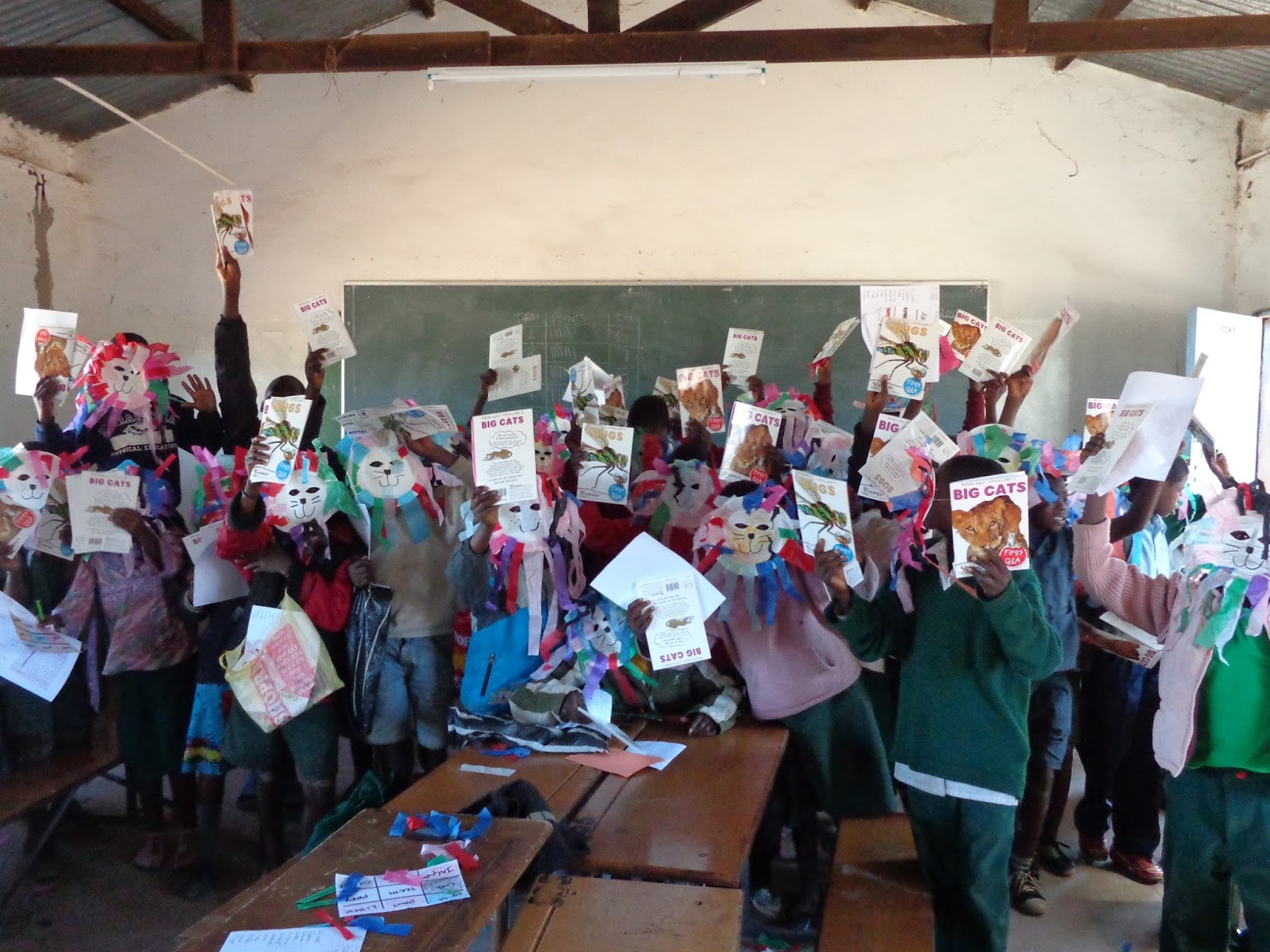
We then drove back to Simoonga, the grade 6 class were hanging out the window frames waiting for us to arrive. The grade 5 and 6 classes are about 40 pupils here, so being just 2 we decided to work with them as just one big group. We based our lessons on the Miles Kelly “Big cats” book.  We had prepared a quiz, so we put the kids in teams, gave them paper and markers and we had questions on big paper. Each team had to find the answer in the book, write it on the paper and hold up the answer before the time ran out! The competition was fierce but they loved it, we followed that with a giant “Big Cat” Bingo, a word search and then lion masks! 


As it is only the 5th week we have been to Simoonga, everything is still new for them; there was a loud cheer when we showed then the prototype mask! However this was very much overshadowed by the giant cheer when we told them they could keep the Big Cat books as well as another, which we handed out! They were over the moon, and kept coming up to ask if they could really take them home. The joy in the classrooms was enormous and infectious. It was really one of the most rewarding days, I can remember! Thank you to Miles Kelly Publishing from the children of Simoonga!

Kelly June 2013